What Next After Your Autism Diagnosis
- Lifetime Access
- Versatile Use
- Neurodiversity-Affirming
- Digital Resource
$50.00
What You'll Get
Lifetime Access
Purchase once and keep it forever

Versatile Use
Suitable for clinicians and community members alike

Neurodiversity-Affirming
Grounded in neurodiversity-affirming practice

Digital Resource
Professionally designed and ready to use
About This Resource
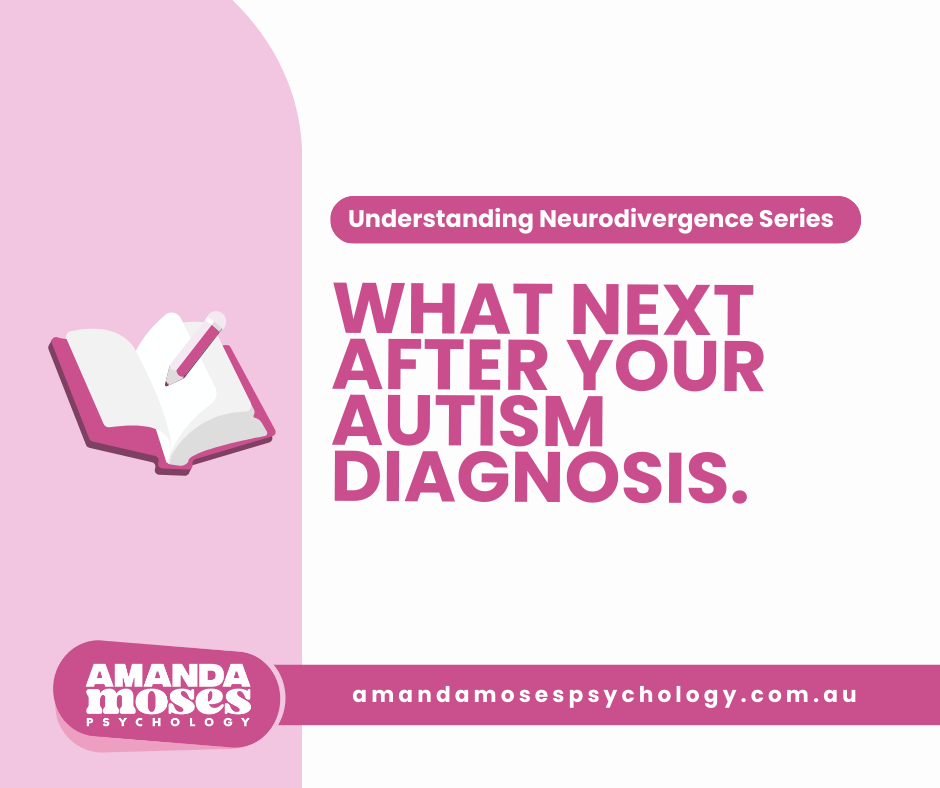
What Next After Your Autism Diagnosis
A Practical Guide to Understanding Yourself and Your Identity Moving Forward
Receiving an autism diagnosis can be a significant and often complex moment in a person’s life. For many people, it brings relief, clarity, questions, and sometimes a mixture of emotions that can take time to process.
This 50-page professionally designed digital guide is intended to support individuals in the period following autism identification. This resource provides a thoughtful introduction to common experiences, questions, and areas of exploration that many autistic people encounter as they begin to understand their diagnosis.
Written in accessible language and grounded in a neurodiversity-affirming perspective, this resource encourages readers to explore their identity, reflect on their experiences, and consider practical ways to support their wellbeing.
Developed by Amanda Moses, a neurodivergent psychologist, the guide combines gentle psychoeducation with reflective exercises designed to help individuals better understand themselves and the broader autistic experience.
What's Included
- Exploring identity and what autism may mean for your sense of self
- Understanding masking and unmasking and how these experiences may show up in daily life
- Learning about sensory processing and sensory needs
- Building supports, accommodations, and helpful routines
- Understanding autistic burnout and recovery
- Exploring self-compassion
- Connecting with the autistic community and finding neurokin
- Considering therapy and other affirming supports
- Navigating change and building a supportive environment moving forward
Who Is This Resource For?
This guide has been developed primarily for:
- Autistic individuals who have recently been identified
- Adults exploring what their diagnosis means for them
- Parents or carers supporting someone newly diagnosed
- Clinicians and allied health professionals supporting autistic clients
It is written to be accessible, compassionate, and reflective, making it suitable for both personal reading and therapeutic discussion.
Format and Access
- 50-page professionally designed digital PDF
- Reviewed by an accessibility expert and graphic designers to optimise readability, visual clarity, and user experience
- Immediate download upon purchase
- Fully revised and expanded 2026 edition
Terms and Conditions
This is a digital product. No physical item will be shipped.
This resource and its contents are the intellectual property of Amanda Moses Psychology. Each purchase is for individual professional use only. If you work in a group practice, each practitioner must purchase their own copy.
Due to the nature of digital products, no refunds are available.
Please review the full terms of purchase here:
Terms of Purchase
Favourites You May Also Like
Autistic Masking and Unmasking
Understanding Camouflaging, Identity, and Safe Pathways Toward Unmasking (2026 Edition)
$70.00
Add to cart
Autistic Burnout: Prevention and Management
A Practical Guide to Understanding, Preventing, and Recovering from Autistic Burnout (2026 Edition)
$80.00
Add to cart
Sensory Regulation for Autistic people
A Neurodiversity-Affirming Guide to Understanding and Supporting Sensory Needs (2026 Edition)
$85.00
Add to cart
Masked Autism: Identification Across the Lifespan
A practical, neurodiversity-affirming training designed to improve recognition of internalised and masked Autism presentations across childh...
$200.00
Enrol NowWhy Psychologists Choose These Resources
Psychologists and allied health professionals across Australia and internationally use these resources to support assessment, therapy and documentation in everyday clinical practice.
Below is a selection of feedback from clinicians who have integrated these tools into their work and found them to be structured, practical and aligned with professional standards.

Amanda's Clinical Resource Bundle has been a game changer, especially the Psychometric Assessment Finder. It has saved me countless hours searching for the right assessments for my clients. I highly recommend Amanda's clinical resources. Not only it is beautifully presented, but it's also easy to navigate and read. It's definitely a time-saver in the busy life of a provisional psychologist.
Amanda's Bundle: Depression, Social Anxiety, and Generalised Anxiety Manuals has been a game-changer for my work in private practice. I was overwhelmed with treatment planning, and these manuals provided a straightforward and pragmatic approach for planning sessions. Amanda's resources have not only streamlined my planning but also enriched my practice with tools such as client-friendly homework worksheets and educational posters. Thank you, Amanda, for creating such an impactful resource!
I recently purchased the Treatment Manuals and I must say I am impressed with its quality and usefulness. What I loved about it was how easy it was to navigate and find the information I needed. The manuals are well-organized and the content is up-to-date and relevant. They have impacted my clinical work positively by saving me time and effort in finding the information I need. Overall, my experience with the products purchased has been great and I would highly recommend it to anyone looking for a reliable and comprehensive clinical resource. I am definitely looking out to see if any manuals for couples therapy or trauma are released to be first in line (or online, lol) to purchase! Thanks again!
Amanda’s templates for depression, anxiety, and social anxiety have helped make my clinical preparation easier and more straightforward. Simple, easy to follow instructions make it a breeze. The manuals walk you through session by session. Guiding you on what to look for, and what to focus on. Lots of handy hints and tips. Hyperlinks make navigation simple, taking you to where you need to go. I’d highly recommend the manuals for anyone looking for a simple and straight forward way to apply CBT skills.
I am completing my Masters in MPP and did a subject on CBT, have multiple books on it and am also working through a TF-CBT training course. I purchased the manual as I thought it might be a useful supplement, but I was WRONG! It is NOT 'just a supplement', but a beautifully laid out, logical and practical approach and complete guide to CBT.
I have used it in sessions with clients, and it has been a wonderful tool to keep on track with sessions and presents information for you as the therapist in accessible and practical ways. It also has some really nice handouts for clients to supplement the session and for them to take home to use for homework. Highly recommended to add to your toolbox.
This seems like the most comprehensive guide to treating depression and anxiety I have ever come across. I love the session by session structure! Thank you so much!
Since returning to work as a psychologist after extended maternity leave to care for my young family, I’ve embarked on a journey and a personal mission to learn as much as I can about neurodiversity affirming practice. It was amazing finding Amanda Moses’ work because I knew I could rely on the information she was providing to be truly NDA, which is something I often worried about earlier on in my journey. I recommend Amanda Moses Psychology to colleagues who endeavor to learn more about NDA practice, and I’m really excited to access further training through Amanda Moses Psychology.
I love the way Amanda has so enthusiastically presented the clinical template bundles. I appreciate this practical nuts and bolts set of resources, which I have tried to make for myself over the last decade and failed ;). Big thanks Amanda!
For anyone engaged in intervention work with clients. I HIGHLY recommend Amanda's manuals. Something beautiful happened yesterday with a client that made the purchase so worth it. After months of what felt like going around in circles with a client who is experiencing severe depression, I made a change to my normal routine. I used the whiteboard in the room to draw graphics from Amanda's manuals and write explanations rather than talking or using graphics from other providers (e.g.. CCI). They walked into the room, immediately saw the whiteboard, stopped for a few minutes and went "that tracks". The light bulb moment was real.
THANK YOU, AMANDA, FOR THIS BEAUTIFUL RESOURCE!!
The quality of resources that are released in Amanda's community every month are second to none. They are relevant, neuroaffirming and so helpful for my practice as a Psychologist. They are jam packed with information, context as to why we choose certain approaches, how to adapt for different presentations. I use these resources all the time.
I really liked the Neuro affirming strategies for ADHD resource I purchased. It’s given me new ideas on how to better work with my neurodivergent clients in a manner that better resonates with them.
I would recommend this resource for other psychologists as it is straightforward and very practical.
Frequently Asked Questions About the Therapy Tools and Clinical Templates
Are these therapy tools ready to be used in sessions with clients?
Yes. Most of the clinical tools are designed to be used directly in therapy and assessment sessions.
Each therapy manual and guide include structured worksheets, reflection exercises, and homework activities that can be introduced in-session and used between appointments. Printable materials are provided so they can be used collaboratively during sessions or shared with clients for ongoing work.
Where relevant, I have also included guidance for clinicians on how to introduce each tool, explain its purpose, and integrate it meaningfully into therapeutic work. The intention is to support active, collaborative therapeutic processes.
Who are these resources designed for?
These resources are designed primarily for psychologists and allied health professionals working in assessment and therapy settings.
They are used by provisional psychologists, early-career clinicians and more experienced practitioners seeking structured, ethically grounded tools.
Resources within the Understanding Neurodivergence Series are also suitable for neurodivergent community members seeking education and self-reflection.
Can I adapt the templates and tools to suit my own practice style?
Yes. All templates are designed to be flexible.
You are encouraged to adapt language, structure and formatting to suit your theoretical orientation, client population and workplace requirements. They provide a strong foundation while allowing professional judgement to remain central.
Can I share these resources with colleagues or students?
Resources are licensed for individual professional use and are not intended for redistribution or resale. If colleagues or students are interested, please direct them to the website to access their own copies.
Can these clinical tools support autism and ADHD assessment work?
Yes. The diagnostic intake tools and report writing guides are designed to support autism and ADHD assessments across the lifespan.
The intake questionnaires assist with gathering detailed information that standard screening tools often miss. They give clients space to reflect on their experiences before assessment and support the collection of meaningful collateral information where appropriate. This helps streamline your process while maintaining clinical depth.
The report writing templates and guides provide a clear structure for organising findings and communicating diagnostic outcomes respectfully and thoroughly. They are particularly useful for clinicians who want a clear, reliable framework for report writing that can be adapted for each individual client.
All tools are grounded in neurodiversity-affirming practice, supporting strengths-based language and thoughtful formulation. They are designed to support clinical judgement and formal training.
Are these resources suitable for early-career psychologists?
Yes. Many provisional and early-career psychologists use these tools to build confidence in documentation, formulation and intervention planning.
They provide structure without oversimplifying clinical complexity.
Are the NPE practice question modules included in the full NPE course?
Yes. The NPE practice question modules are included in the full version of the NPE preparation course.
They are available separately for those who prefer focused practice questions or who do not intend to purchase the full preparation package.
Do you offer payment plans for your psychology resources?
Flexible payment options are available at checkout through third-party providers such as Afterpay and PayPal, depending on eligibility and provider terms.
Amanda Moses Psychology is not affiliated with these providers. All approvals and payment arrangements are managed directly by the third-party provider.
Contact Amanda Moses Psychology
I provide a range of services to support psychologists at every stage of their career.
Get In Touch
Have a question that isn’t answered on my site? Drop us a message below. We aim to respond within 5 business days.